
click to Home
Article ES9 Disabled Vets learn to ski/board on an Endless Slope Back to Articles
Related Articles:
Articles:
Ski & Board Tips:
Vets learn to ski/board at Orlando expo
By Sam Morishima
Feb. 2009 issue of Sierra Ski News
|
|
|
|
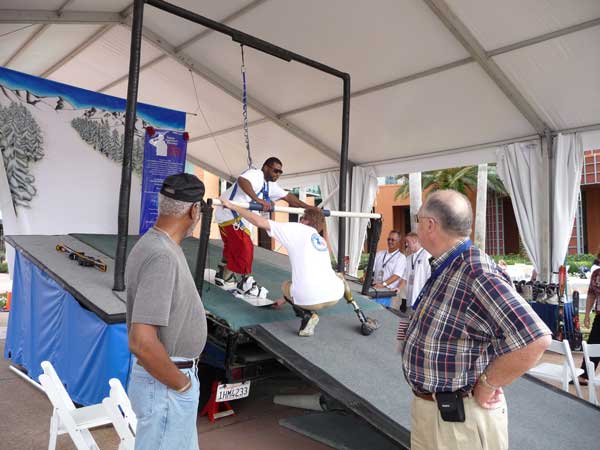
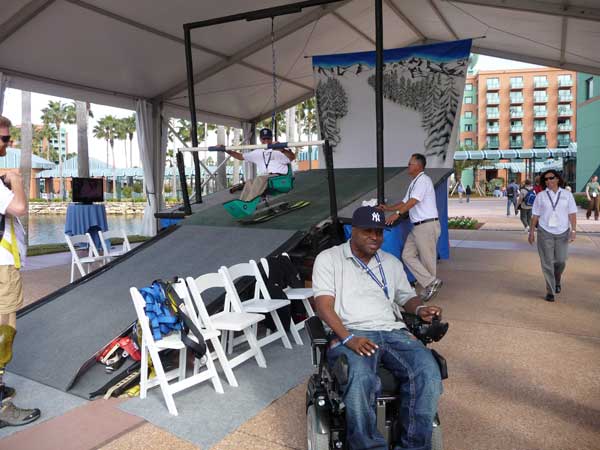
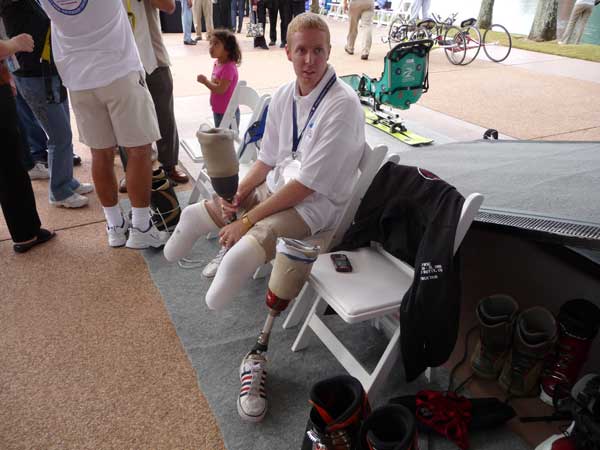
| Brent Teaching a vet with a missing lower leg | Mike on a Bi-ski used by paraplegics' | BJ taking a load off his leg before skiing |
There comes a time when you realize that terrible things happen and they can happen to the best of people. Loss of arms, legs, or the full function of the mind. Or losing the feeling and muscle control from the waist down - or even worse - from the neck down. These are some of the situations our disabled veterans find themselves in. Recently injured from duties in Afghanistan, Iraq and other places in our world where conflicts exist they come to gather at a conference that honors them.
In December 2008 they were honored at the “Salute Our American Heroes, Road to Recovery” conference in Orlando, Florida at the Disney World Resort. I was privileged to be part of Mark Wellman’s Adventure Sports Expo where we worked with the veterans at the conference to introduce them to outdoor sports such as skiing, snowboarding, rock climbing and bicycling.
Most of them, I learned had enjoyed such sports prior to their injuries. Now they had no idea if they would ever perform them again. With the use of modified equipment(s), refined specific techniques, the aid of experienced instructors and the Endless Slope they learned to overcome their doubts.
They experienced skiing and snow-boarding in Orlando Florida at the Walt Disney grounds between the Swan and Dolphin hotels on the Endless Slope as well as scaling a rock face on a climbing wall and maneuvering through an bicycle obstacle course pedaling a futuristic looking Tri-bike powered by a hand pedal and steered by their chest. By accomplishing a sport they thought was now beyond their reach they discovered a renewed hope for success.
With life made difficult by their injuries, finding their ability to perform once again in sports they loved to do before their unfortunate circumstance gave them hope and the desire to accomplish what ever came before them. It restarted the cascade to succeed in other aspects of their life, broadening their capabilities to take on other opportunities and challenges.
Providing the veterans to acheive at physically and skillfully demanding activities at the conference provided the veterans with the confidence, motivation and attitude to further go past and beyond barriers that life sets before them.
By assisting the veterans to practice appropriate techniques specific for their condition with adaptive equipment(s) allowed them to perform the sport. They quickly discovered that they may even have a chance to compete in the Special Olympic events.
They discovered that they were not limited by their disabilities, but by their desire to train and work to master their technique, strategies and knowledge of the sport. So with the aid of innovative equipment's, appropriate skill developments, proper training specific relative to their situation and their desire for accomplishing the sport they found the possibilities to reach endless heights.
With skiing and snow-boarding, we first showed them how they could achieve the ride. They were then properly fitted with boots, if required, and the board or skis, or sitting bi-skis. Then they were harnessed either into a sitting bi-ski for the paraplegics or in a standing body harness for those who have enough motor skills to walk. The harnessing provided them with safety and security resulting in limited falling.
Because the surface of the Endless Slope moved under the skier or boarder, harnessing the rider was possible as they remained skiing or boarding pretty much in a transverse line riding back and forth. As a note, just because the rider rode and turned back and forth along a lateral line it doesn’t mean that they did not feel the pull of gravity down a slope. The rider is pulled down toward the bottom of the moving slope but is able to maintain the lateral riding across the slope maintained at a specific height on the slope by edge to edge carving of the ski or snowboard just like on a snow covered mountain slope. So in essence from a physics stand point they were actually skiing and snowboarding.
The advantage of the Endless Slope as a training tool is that it allowed us to provide the rider with training aids that gradually allowed for greater independence as they developed appropriate skills to handle more demanding riding. Such aids as harnessing the rider or a training bar for added stability so they could develop the proper skills and technique to eventually ride hands free. It also allowed the instructors to easily aid the rider by being easily and conveniently in front of them or behind them at all times.
The instructor in front could stand in front helping point out or guide the rider and the instructor behind typically skied behind on the Endless Slope along with the rider assisting when necessary from the back.
The Endless Slope advantage for the rider is they were actually skiing or boarding, experiencing the same sensations, thrills and excitement as on the mountain. Once they were shown how to control the ride we allowed them to go solo with us being right there to assist them if they had any trouble.
Using specialized equipment to optimize their ride, they discovered the enhanced possibilities to maneuver on skis and snowboard. The outcome was the ability to soar once again on skis and snowboards - feeling the stable balance, speed and turning. They became an athlete in control of their destiny. On the Endless Slope they not only experienced the ride but received instant feedback of their development to control the skis or board or bi-ski. They became confident in themselves discovering that endeavors in sports are not beyond their reach.
For many of us who are able-bodied, such sports as skiing and snowboarding can be daunting, but for the recently disabled veterans these activities may seem impossible. They feel excluded from participating from such sports - both physically and mentally. They have an acute sensitivity to limitations, making things seem impossible with the disappointing fear of failing. Such thoughts of failure becomes a disgusting dark cloud that relentlessly hangs over them. Because of this, they approach sports with a greater doubt of fear. A fear they feel they have two or three strikes against them from the begining.
I had the privilege of working alongside with some of the best instructors, coaches, special Olympians and athletes at this conference. I saw the smiles of our veterans as they discovered and grasped the ability to accomplish these sports. I saw them perform by making slightly adjustments for making up for lost limbs and other debilitating aspects of their injuries, modifying movements that help create or maintain control and using specialized equipment and technology to further their comfort, position, stability and steering.
Skiing and snowboard lessons performed at Orlando’s Walt Disney World, as I mentioned earlier, was done on my Endless Slope a mechanical moving mountain-like machine that has an inclined revolving carpeted surface that allows continous skiing and snowboarding. This particular Endless Slope was once used by the Rossingol ski team for training and demonstrating the sport and now it is used to teach disabled bodies that skiing and snowboarding to them. A very fitting use of this machine.
Mark Wellman drove the Endless Slope on a 19-foot trailer from California as I rode shotgun. For those who do not know Mark, he is an accomplished wheel chair athlete who was the first paraplegic to have scaled El Captain in Yosemite. He has also crossed the Sierra Nevada on a sit ski, was a two-time Para Olympian, and has accomplished many other of his outdoors passions. Mark drove all the way, not trusting me to drive his prized diesel truck that he purchased when he was a Para Olympian.
The advantage of the Endless Slope, besides allowing us to ski and snowboard in Orlando, Florida, (where snow has as much of a chance to exist as your money does with crooked investment firm,) is that we could safely train and develop the veteran’s ability to perform the sport with their capabilities.
For those of us who are able bodied, to ski and snowboard becomes a special thrill. For someone who has lost something of themselves, it is more like a miracle. For these young veterans it is a healing process to help them come a little bit closer towards enjoying a life that has been turned upside down. It provides not only a personal best, but rewards one with something only a sports achievement can give, which is controlling our bodies at an athletic level.
Paraplegic veterans skied in a specially designed seated bi-ski which was invented by Mike Miltner, who I was fortunate to assist on the endless slope. It was simply amazing to see how the riders developed their balance and controlled their steering through subtle weight shift.
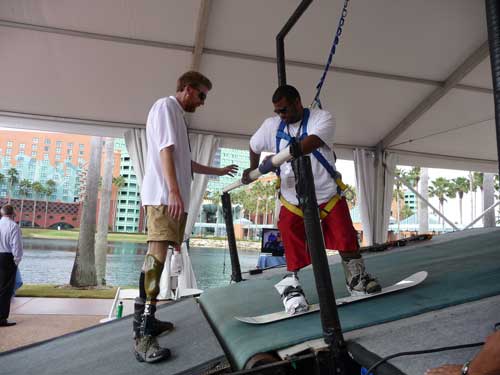
Single and double leg amputees were taught to snowboard and ski under the guidance of Coach Brent Kuemmerle. Brent, a one-leg amputee, is one of the top snowboard instructors in the country. Brent mentions to his leg amputee students that snowboard boots are not necessary for the prosthetic foot telling them that frostbite is not an option for the false foot. Brent uses towels, cardboard and any other materials to secure the prosthetic foot, with a regular walking or running shoe on it, into the snowboard binding.
I discovered quickly that working with such individuals you are not only dealing with the obvious physical disabilities, but also the hidden and not so obvious injuries of mental challenges brought upon them from brain injuries, mental stress, problems of family, etc., brought on by their handicapped, dysfunctional, damaged conditions and appearances. Working with traumatic injured persons is not simply dealing with their physical injuries, but with sudden outburst from depression, sadness to aggressive stubbornness and anger. We were fortunate that what we experienced from them were the joys and thrills brought on by the accomplishment of them skiing and snowboarding. Maybe, because they are recent veterans that they still carried fresh deep inside them the military discipline and they were very controlled in their actions and responses.
You not only saw in them, but felt in them the pride and strength of themselves and the courteousness they gave to others. As I worked with them they always acknowledge me, calling me “sir,” something I am not use to hearing, but made me very humble and proud to be there.
Even with the youthful strength of these young veterans you can still feel the tensions in them that they bear their injuries not only on the outside, but within. They must live with such disabilities for the rest of their lives as they go forth to make the best for themselves and their family. It is the participation in such sports that give hope that limitation of oneself is only in the not trying.
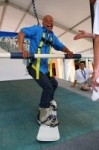
Many of the veterans left with the belief that life can still be enjoyed fully even with disabilities. Sometimes the real disabilities are not seeing the value of things we should do and being afraid and not try something we want to do.
(RJ disabled vet on snowboard, now a TV actor on "All My Children" having a go on the Endless Slope)
As an instructor, it was a learning experience of a lifetime. Working outside the box, examining new ways to teach individuals to accomplish controlling a pair of skis or a snowboard with a severe injury or disability. This has given me a greater understanding of skiing and snowboarding which I would not have realized by conventional teaching methods.
For me personally, I realize how fortunate I am to have what I have. As I further develop myself as a skier, a snowboarder and as an instructor I have a stronger appreciation of the gift that these sports offer not only to me but to others. The recently injured veterans are overcoming not only physical limitations but mental stress of adjusting to their changed life. This affects not only themselves, but wife and children, relatives, friends, community and society. They shoulder the burden of sacrifice for our freedom to enjoy our way of life in the United States so that we may pursue happiness.
So if you see one on the slopes, give them the right of way so they may enjoy the ride.
Sam Morishima is a Contributing Editor for Sierra Ski News and Director of the SnoZone Ski & Snowboard School. Sam can be reached at snozone@pacbell.net or visit www.endlesslope.com.
Back to Articles